
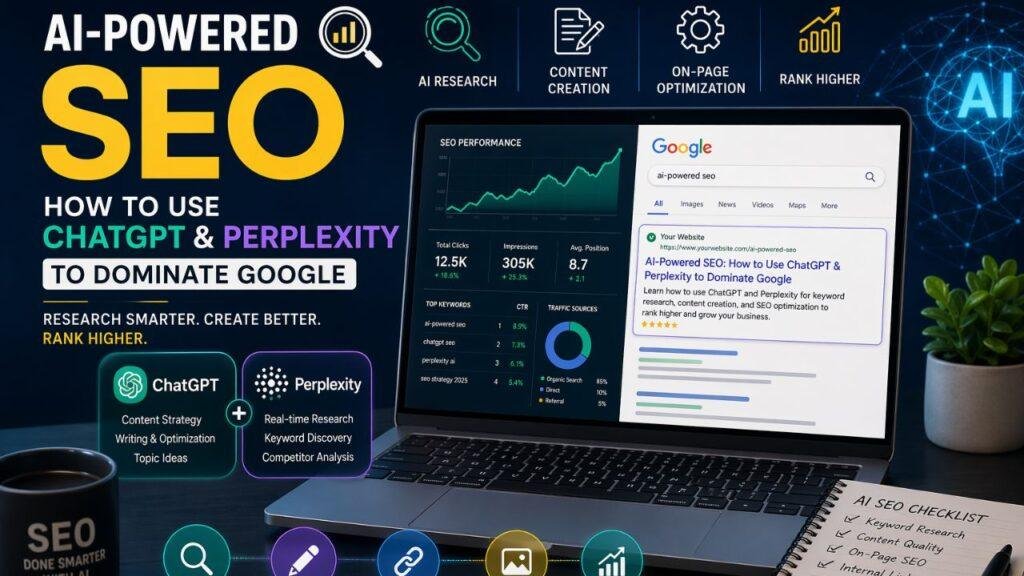
AI-Powered SEO is changing the way businesses grow online. If you are still relying only on traditional SEO methods, you are already falling behind your competitors. Today, the businesses ranking on Google’s first page are not just working harder — they are working smarter, using AI tools like ChatGPT and Perplexity to research faster, create better content, and stay ahead of every algorithm update.
In this guide, I will show you exactly how AI-Powered SEO works, why ChatGPT and Perplexity are the two most powerful tools available right now, and how you can use them to dominate Google — even if you are a small business or just getting started with SEO.
What Is AI-Powered SEO?
AI-Powered SEO is the process of using artificial intelligence tools to plan, research, create, and optimize your website content for search engines — faster and more accurately than traditional manual methods ever allowed.
Traditional SEO works like this: you guess a keyword, write content around it, wait months to see if it ranks, and then adjust. It is slow. It is uncertain. And in competitive markets, it often is not enough.
AI-Powered SEO works differently. Instead of guessing, AI analyzes millions of data points from real search behavior, identifies exactly what Google rewards, and gives you a clear, data-backed path to rank higher. You stop guessing and start making decisions based on real evidence.
Think of traditional SEO as fishing in the dark. AI-Powered SEO gives you a map that shows exactly where the fish are — and the best time to catch them.
The two tools that make this possible better than anything else right now are ChatGPT and Perplexity AI. They serve different but complementary purposes, and together they cover every stage of a complete SEO strategy.
Why ChatGPT and Perplexity AI Are the Best Tools for AI-Powered SEO
Before diving into the strategy, it is important to understand what each tool does best so you use them in the right situations.
ChatGPT (especially GPT-4o) is a world-class writing and strategy assistant. It excels at creating content outlines, writing in a natural human tone, building topical authority maps, generating meta descriptions, and refining your content structure. It is the tool you use to think, plan, and create.
Perplexity AI is a real-time research engine. Unlike ChatGPT, it actively searches the web, cites current sources, and delivers up-to-date information from across the internet. For keyword discovery, competitor research, trending topic analysis, and finding content gaps, Perplexity is unmatched.
When you combine the research power of Perplexity with the content intelligence of ChatGPT, you get a complete AI-Powered SEO system that covers everything — from finding the right keywords to publishing content that actually ranks and converts.
Step 1 — Use Perplexity AI to Find Keywords Your Competitors Are Missing
Every successful SEO campaign starts with understanding what your target audience is actually searching for. This is where most businesses go wrong. They choose keywords based on instinct instead of real search data — and then wonder why their content never ranks.
Perplexity changes this completely.
Open Perplexity AI and type a research prompt like this:
“What are the most searched questions and long-tail keywords related to AI-Powered SEO in 2025? Include search intent for each keyword.”
Perplexity will immediately pull current data from across the web, present organized results, and cite real sources so you can verify the information. Within minutes, you will have:
- High-intent long-tail keywords your competitors are probably ignoring
- Real questions your audience is typing into Google right now
- Current trending subtopics you can write about before anyone else does
- Search intent signals so you know exactly what type of content to create for each keyword
After getting your keyword list, group them by intent. Informational keywords (“what is AI-Powered SEO”) are for educational blog posts. Commercial keywords (“best AI SEO tools”) are for comparison content. Transactional keywords (“hire an AI SEO expert in Bangladesh”) are for your service pages. This grouping is critical — Google matches content to intent, and mismatched content almost never ranks well.
Step 2 — Build a Topical Authority Map Using ChatGPT
Here is one of the most important things Google looks for today that most website owners still do not fully understand: Google does not just rank individual pages. It ranks websites that demonstrate deep, consistent expertise on a topic.
This is called topical authority. To build topical authority, you need more than one great blog post. You need a network of related content — pillar pages and supporting articles — all connected through internal links, all covering different angles of the same subject. This tells Google that your website is a genuine expert resource on your niche.
ChatGPT makes building this structure fast and strategic.
Use a prompt like this:
“I run an SEO consulting website targeting businesses in Bangladesh and internationally. Create a complete topical authority content map for the topic ‘AI-Powered SEO.’ Include one main pillar page, supporting cluster articles, and internal linking suggestions between them.”
ChatGPT will return a structured content roadmap with 20 to 30 topic ideas, organized in a way that builds authority logically. Instead of publishing random blog posts and hoping for results, you now have a deliberate content strategy that compounds in value every time you publish a new article.
This is exactly how high-ranking websites operate. With AI, you can build this strategy in minutes instead of weeks.
Step 3 — Write Content That Reads as a Human Expert Wrote It
This is where most people make the biggest and most costly mistake with AI-Powered SEO. They open ChatGPT, type “write me a blog post about AI SEO,” copy the output, and paste it directly onto their website.
This approach fails — and sometimes it actively hurts rankings.
Google’s Helpful Content system is sophisticated enough to detect content that is generic, shallow, or clearly produced by AI without expert oversight. It penalizes this kind of content and rewards content that demonstrates genuine experience, real insight, and authentic value for the reader.
The good news is that getting great results from ChatGPT is not difficult — it just requires the right approach.
Here is the exact process I recommend:
First, add your own perspective before you write. Jot down two or three real thoughts, opinions, or personal experiences you have about the topic. These become the human layer of your content — the thing that makes it genuinely yours and impossible to fake.
Second, give ChatGPT a specific and detailed prompt. Instead of asking it to write the whole post, ask it to help you write one section at a time. For example:
“I am writing a guide on AI-Powered SEO for small business owners. Here is my outline: [paste your outline]. Help me write Section 3 in a conversational, expert tone — direct and practical, like an experienced SEO consultant explaining it to a motivated client.”
The output you get from a specific, context-rich prompt is dramatically better than what you get from a vague one. It will be more natural, more structured, and far more useful to your readers.
Third, edit with purpose. After ChatGPT gives you a draft, read it out loud. Add your own examples. Remove any sentence that feels vague, generic, or that does not add real value. If a paragraph does not earn its place in the post, delete it.
Fourth, check your readability. Yoast SEO recommends keeping your Flesch Reading Ease score above 60. Write short sentences. Keep your paragraphs to three to four lines maximum. Use transition words like “however,” “because,” “for example,” and “as a result” to guide readers naturally from one idea to the next. Avoid passive voice wherever possible.
Step 4 — Optimize Your On-Page SEO with Precision
Writing excellent content is only one part of the equation. Without proper on-page optimization, even the best content struggles to rank. This is where you apply the technical Yoast SEO checklist to every piece of content you publish.
Here is what perfect on-page AI-Powered SEO looks like:
Focus Keyword Placement
Your focus keyword — in this case, AI-Powered SEO — must appear in these specific locations:
- The SEO title, ideally within the first 60 characters
- The first paragraph of your content, within the first 100 words
- At least one H2 subheading
- The meta description
- The alt text of your featured image
- Naturally, throughout the body, at a density of approximately 1 to 2 percent — never stuffed
Use ChatGPT to audit your draft. Ask it: “Review this blog post and check if the keyword ‘AI-Powered SEO’ is placed naturally in all the right positions according to Yoast SEO guidelines.” It will flag what you missed.
Meta Description
Your meta description must be between 120 and 155 characters. It must include your focus keyword and give readers a compelling reason to click your result over everyone else’s. Write it like a mini-advertisement — specific, benefit-driven, and direct.
For this post, a strong meta description would be:
Discover how AI-Powered SEO using ChatGPT and Perplexity can help your business rank higher on Google, drive organic traffic, and grow faster in 2025.
Internal Linking
Every blog post should link naturally to two or three other pages on your website. If you have service pages on Local SEO, E-Commerce SEO, Digital Marketing, or your AI-Powered SEO service, link to them wherever the topic connects naturally. Internal links keep visitors on your website longer, pass SEO authority between pages, and help Google understand the structure and depth of your content.
Image Optimization
Every image you use must have a descriptive alt text that includes your focus keyword where relevant. For example: “AI-Powered SEO strategy using ChatGPT and Perplexity.” This helps Google understand your images and improves your chances of appearing in Google Image Search — an often-ignored source of additional organic traffic.
Step 5 — Use Perplexity to Analyse Your Competitors and Find Content Gaps
One of the fastest ways to improve your Google rankings is to study what is already working for your competitors — and then do it better. This is called competitive gap analysis, and Perplexity makes it faster than any other method available today.
Try this research prompt in Perplexity:
“Analyse the top-ranking pages for ‘AI-Powered SEO 2025.’ What topics do they cover? What questions do they answer? What important angles or subtopics are they missing?”
Perplexity will review the current top results and return a structured breakdown. From that analysis, you will be able to:
- Identify exactly what topics Google considers essential for this subject
- Spot the specific subtopics your competitors ignored — these are your content gap opportunities
- Understand what content format Google currently prefers for this keyword (detailed guides, listicles, case studies, comparison posts, etc.)
- Find questions readers are asking in the comments and forums that no top article has answered
Your job is then simple: write content that covers everything the top results cover, goes deeper on the subtopics they covered lightly, and answers the questions they ignored entirely. This approach — often called the Skyscraper Technique — consistently produces ranking results. AI just makes it 10 times faster to execute.
Step 6 — Track Performance and Keep Improving
AI-Powered SEO gives you a massive head start — but SEO is always a long-term strategy. You need to monitor your results regularly, identify what is working, and continuously improve.
Here is what to track every month without fail:
Google Search Console — This is your most important free tool. Monitor your impressions, click-through rate, and average position for every target keyword. When a page starts gaining impressions but has a low click-through rate, that is a signal that your title or meta description needs improvement.
Google Analytics 4 — Track which blog posts drive the most organic traffic, how long visitors stay on each page, and which content converts visitors into leads or customers.
Core Web Vitals — Google uses page speed and user experience as ranking factors. Make sure your website loads fast, especially on mobile devices. A slow site loses rankings, no matter how good the content is.
Keyword Rankings — Use a tool like Google Search Console, Ahrefs, or Ubersuggest to track where your target keywords are ranking week by week.
Once you have data, bring it back into ChatGPT. For example:
“My blog post on AI-Powered SEO has a 72 percent bounce rate and an average session time of 48 seconds. Based on these numbers, what improvements should I make to the content to increase engagement and time on page?”
You will get specific, actionable suggestions instantly — saving you hours of guesswork.
Common Mistakes That Kill AI-Powered SEO Results
Understanding what to do is important. Understanding what to avoid is equally important. These are the most common mistakes I see businesses make when they start using AI for SEO:
Publishing AI content without proper editing. Raw AI output is a first draft, not a final product. Always review, refine, and add your own experience and voice before publishing.
Ignoring search intent. High search volume means nothing if the content you create does not match what the searcher actually wants. Always match your content type to the search intent behind the keyword.
Keyword stuffing. Using your focus keyword too many times in forced or unnatural ways is flagged as spam by Google. Aim for a natural density of 1 to 2 percent — no more.
Skipping E-E-A-T signals. Google evaluates content based on Experience, Expertise, Authoritativeness, and Trustworthiness. Include a professional author bio, cite credible sources, link to your credentials and case studies, and show real-world evidence of your results.
Expecting instant results. Even with AI-Powered SEO, ranking on Google takes time. Most businesses start seeing meaningful improvements within 90 to 150 days of consistent, quality publishing. The businesses that win are the ones that stay consistent and keep improving.
Why AI-Powered SEO Is the Future of Digital Marketing
AI tools like ChatGPT and Perplexity are not just new technology — they are fundamentally changing who can compete in organic search. Until recently, a comprehensive SEO strategy required a full team of researchers, writers, strategists, and technical experts with a significant budget to match.
Today, a single business owner with the right AI tools and the right knowledge can execute the same level of strategy in a fraction of the time and cost.
But here is what will never change: AI provides the speed and scale. Your expertise, judgment, and genuine understanding of your audience provide the quality.
The businesses that will dominate Google over the next five years will not be those that use AI the most. They will be those that use AI the smartest — pairing powerful tools with real human insight and a genuine commitment to helping their audience.
This is exactly what AI-Powered SEO, done correctly, delivers.
Conclusion
AI-Powered SEO is not a shortcut. It is a smarter, faster, and more effective way to build sustainable organic growth on Google.
By combining the real-time research power of Perplexity with the content intelligence of ChatGPT, and layering in precise on-page optimization following Yoast SEO best practices, you create a system that produces consistent results — not just a single ranking page, but a compounding library of content that grows your authority and traffic month after month.
Start with one keyword. Build one piece of content using the process outlined in this guide. Measure the results. Refine it. Then repeat. That is how serious SEO growth is built — not with shortcuts, but with a system that works.
If you want a customized AI-Powered SEO strategy built specifically for your business, contact Md Mahmodul Hasan today. Whether you need Local SEO, E-Commerce SEO, or a full Digital Marketing strategy, I help businesses across Bangladesh and internationally achieve real, measurable organic growth.
Let’s build your Google presence — the smart way.