
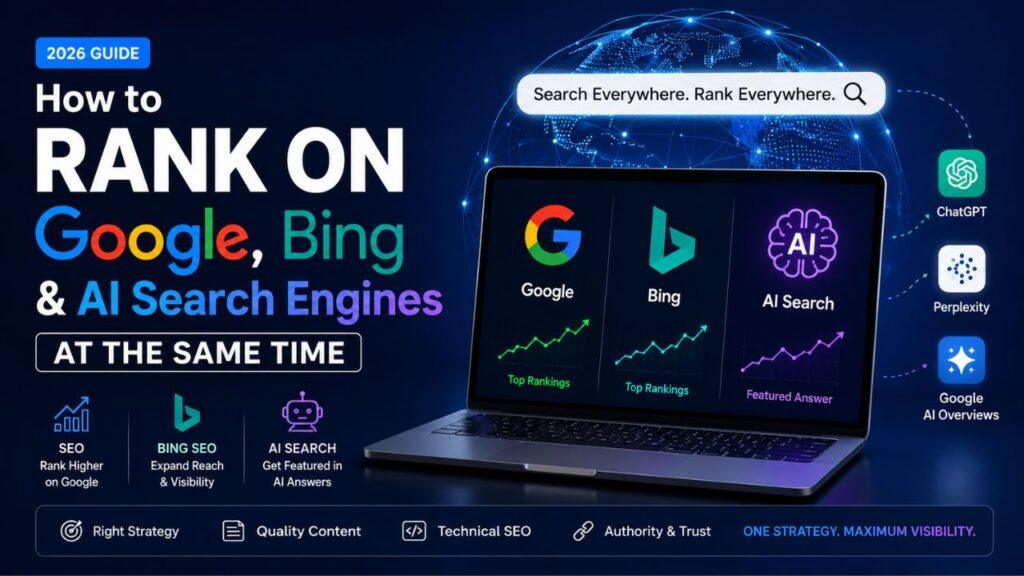
Ranking on search engines is no longer just about Google. Today, platforms like Bing and AI-powered search engines such as ChatGPT, Perplexity, and Google’s AI results are changing how users discover information.
So, the real question is: how can you rank everywhere at once?
In this guide, I’ll break down a practical and modern strategy to help you rank on Google, Bing, and AI search engines simultaneously using a combination of SEO, AEO (Answer Engine Optimization), and GEO (Generative Engine Optimization).
Why Traditional SEO Alone Is Not Enough
For years, SEO was focused on ranking web pages on Google. However, search behavior has changed significantly.
Now:
- Users ask questions directly to AI tools
- Search engines provide instant answers instead of just links
- Content is evaluated based on clarity, authority, and usefulness
As a result, if you rely only on traditional SEO, you are missing a huge portion of traffic.
That’s where AEO and GEO come in.
Understanding SEO, AEO, and GEO
Before we go deeper, let’s clarify these three concepts:
1. SEO (Search Engine Optimization)
This focuses on ranking your website on search engines like Google and Bing using:
- Keywords
- Backlinks
- Technical optimization
- Content quality
2. AEO (Answer Engine Optimization)
AEO is about optimizing your content so it can be selected as a direct answer by search engines and voice assistants.
For example:
- Featured snippets
- “People Also Ask” results
- Voice search responses
3. GEO (Generative Engine Optimization)
GEO is the future. It focuses on optimizing content for AI tools that generate answers instead of just listing websites.
Examples include:
- ChatGPT
- Perplexity AI
- Google AI Overviews
Step-by-Step Strategy to Rank Everywhere
Now let’s get into the actionable part.
1. Start With Smart Keyword Research
First, you need to target the right keywords. However, don’t just focus on high-volume keywords.
Instead:
- Use long-tail keywords
- Focus on question-based queries
- Target user intent
For example:
Instead of “SEO tips,” use:
- “how to rank on Google Bing and AI search engines”
- “SEO strategies for AI search”
This approach improves both SEO and AEO performance.
2. Optimize Content for Search Intent
Google and AI tools prioritize content that matches user intent.
There are three main types:
- Informational
- Navigational
- Transactional
Make sure your content clearly answers the user’s query within the first few paragraphs.
Also, use:
- Clear headings (H2, H3)
- Short paragraphs
- Simple language
This improves readability and increases your chances of being selected by AI engines.
3. Structure Content for AEO (Answer Engine Optimization)
To rank in featured snippets and AI answers, your content must be structured properly.
Use:
- Bullet points
- Numbered lists
- Direct answers
For example:
Question: How to rank on multiple search engines?
Answer: Use a combination of SEO, AEO, and GEO strategies including keyword optimization, structured content, and authoritative signals.
This format makes it easier for search engines to extract your content.
4. Build Topical Authority
If you want to rank consistently, you need to become an authority in your niche.
Instead of writing random blogs, create content clusters.
For example:
- Main topic: SEO strategies
- Supporting topics:
- On-page SEO
- Technical SEO
- AI SEO
- Link building
This signals to Google and AI engines that your website is a trusted source.
5. Optimize for Bing (Most People Ignore This)
Many people focus only on Google, but Bing is still powerful—especially because it powers many AI systems.
To rank on Bing:
- Use exact-match keywords naturally
- Ensure strong on-page SEO
- Focus on domain authority
- Use high-quality backlinks
Also, Bing tends to favor older domains and structured content more than Google.
6. Focus on E-E-A-T (Experience, Expertise, Authority, Trust)
Both Google and AI engines evaluate your credibility.
To improve E-E-A-T:
- Add author bio
- Show real experience
- Include case studies
- Use credible sources
For example, sharing your own SEO results builds trust and increases ranking potential.
7. Optimize for AI Search (GEO Strategy)
AI engines don’t just rank pages—they understand and summarize content.
To optimize for this:
- Write clear, factual, and well-structured content
- Avoid fluff and unnecessary complexity
- Use semantic keywords
- Answer multiple related questions
Also, keep your content updated because AI tools prefer fresh and relevant information.
8. Improve Technical SEO
Without technical optimization, your content won’t perform well.
Make sure:
- Your website loads fast
- It is mobile-friendly
- URLs are clean and simple
- You use schema markup
Schema helps search engines understand your content better, which improves both SEO and AEO.
9. Use Internal Linking Strategically
Internal links help search engines discover your content and understand your site structure.
Best practices:
- Link to relevant pages
- Use keyword-rich anchor text
- Avoid over-linking
This improves crawlability and boosts rankings across all platforms.
10. Track, Test, and Improve
Finally, SEO is not a one-time task.
You need to:
- Monitor rankings
- Analyze traffic
- Update content regularly
Tools like Google Search Console and Bing Webmaster Tools can help you track performance.
Final Thoughts
Ranking on Google, Bing, and AI search engines at the same time is not impossible—it just requires a smarter approach.
Instead of relying only on traditional SEO, you must combine:
- SEO for rankings
- AEO for direct answers
- GEO for AI visibility
If you apply these strategies consistently, you will not only rank higher but also future-proof your website in the evolving search landscape.
FAQs
How do I rank on Google Bing and AI search engines?
You need to combine SEO, AEO, and GEO strategies, including keyword optimization, structured content, and authority building.
What is GEO in SEO?
GEO (Generative Engine Optimization) focuses on optimizing content for AI-powered search engines that generate answers.
Is SEO still relevant in 2026?
Yes, but it has evolved. SEO now works alongside AEO and GEO to maximize visibility across platforms.